For reference, anomalies:


For reference, oxygen (CAIs .. more along "CCAM"):

For reference, D/H (Jupiter .. protosolar):

a shock-age model for Flora?
Ang shock ages?
Bra shock ages?
Pal shock ages? (not found)
CC irons (IID, IVB) shock ages?
CC irons CRE ages?
H, L, LL formation ages?
HED formation ages?
iron IAB^non-magmatic .. Kalliope?
iron IIIAB^magmatic .. Hertha?


Sequence of condensation lines:

|H2O |NH3 |CO2 |CH4 |N2  |CO
|    |    |    |    |    |
165  85   75   35   25   22


Sequence from anomalies:

Ure HED+Pal+Mes Aca Ang LL L H Mars EC IAB! Earth+Moon R | CO+CK+CV CM CB CR CI  CAI
                                         <- neutron-poor | neutron-rich, s-process, SN, pre-solar grains ->

from oxygen:

CAI  CO+CK+CV CR CH Ure! CM | Aca-Lod HED+Mes+Pal Ang Bra IAB Win Earth+Moon Mars EC IIE H L LL IVA R CI! CM_meta CI_meta
               <- shielding | evaporation ->

from fugacity:

CAI Aub Ure EC IIE IIIAB IAB CB CH Aca H L LL Pal | R CR Bra Ang HED CO CV CK CM CI
                                       <- reduced | oxidized ->

from ages:

IC..IVA Ang Ure Mes Aca-Lod IAB! Win | Aub EH EL H L LL R IIC..IVB CO CV CH CR CM CI CB
                            <- early | late ->
--

Known formation regions:

HED+Pal+Mes .. ???, neutron-poorest, evaporation a bit, oxidized (core-formation?), earliest
Ure         .. ???, neutron-poorest, shielding as CCs!, highly reduced!, earliest!

Ang         .. ???, neutron-poor, evaporation, oxidized (core-formation?), earliest
Bra         .. ???, neutron-poor, evaporation, oxidized (core-formation?), early
Aca-Lod     .. ???, neutron-poor, evaporation a bit, reduced, early

Earth+Moon  .. 1 au, oxidized (core-formation)
IAB         .. ???, neutron-poor as Earth!, evaporation, reduced, early-to-late
Win         .. ???, neutron-poor, evaporation, reduced, early-to-late

EC          .. NEO, Mars-crossers, or E-belt?, neutron-poor, evaporation, highly reduced, late

Mars        .. migration ^^^ (Dauphas et al. 2024)

H           .. main belt, neutron-poor, evaporation, reduced, late
L           .. main belt, neutron-poor, evaporation, reduced, late
LL          .. main belt, neutron-poor, evaporation, reduced, late

IIIAB       .. ???, neutron-poor, evaporation, reduced, early
R           .. below snowline?, neutron-poor a bit, evaporation, oxidized a bit, late
K           .. also below snowline? (Marrocchi et al. 2024)

-- H2O

CO+CK+CV    .. Jupiter?, neutron-rich, most shielding, oxidized, late
CR          .. ???, neutron-rich, shielding, oxidized, latest
CH          .. ???, neutron-rich, shielding, reduced (metal), latest
CB          .. ???, neutron-rich, shielding, reduced (metal), latest
CM          .. trans-Saturn, neutron-rich, least shielding, oxidized, latest

-- NH3
-- CH4

CI          .. trans-Neptune, neutron-richest, evaporation a lot!, oxidized, latest


Note: See Clayton (1983) on irons.
Note: See Baker et al. (2005) on angrites.
Note: See Greenwood et al. (2007) on primitive achondrites.
|
For reference, anomalies: |
For reference, oxygen (CAIs .. more along "CCAM"):
|
For reference, D/H (Jupiter .. protosolar):
|
Anomalies of Ti, Ca, Cr, Sr, Zr, Ba, Nd (litophile):
| Ti vs. Ca | Ti vs. Cr | Ti vs. Sr | Ti vs. Zr | Ti vs. Ba | Ti vs. Nd |
 |
 |
 |
 |
 |
 |
Anomalies of Mo, Ni, Ru, W (siderophile, i.e., for irons):
| Mo | Mo vs. Ni | Mo vs. Ru | Mo vs. W |
 |
 |
 |
 |
Note IAB irons <=> Earth, other irons <=> Ure, Ang, Aca?!
| class | crystallisation, core-formation | shock | exposure | notes |
| H |  |
 |
 |
|
| L | |
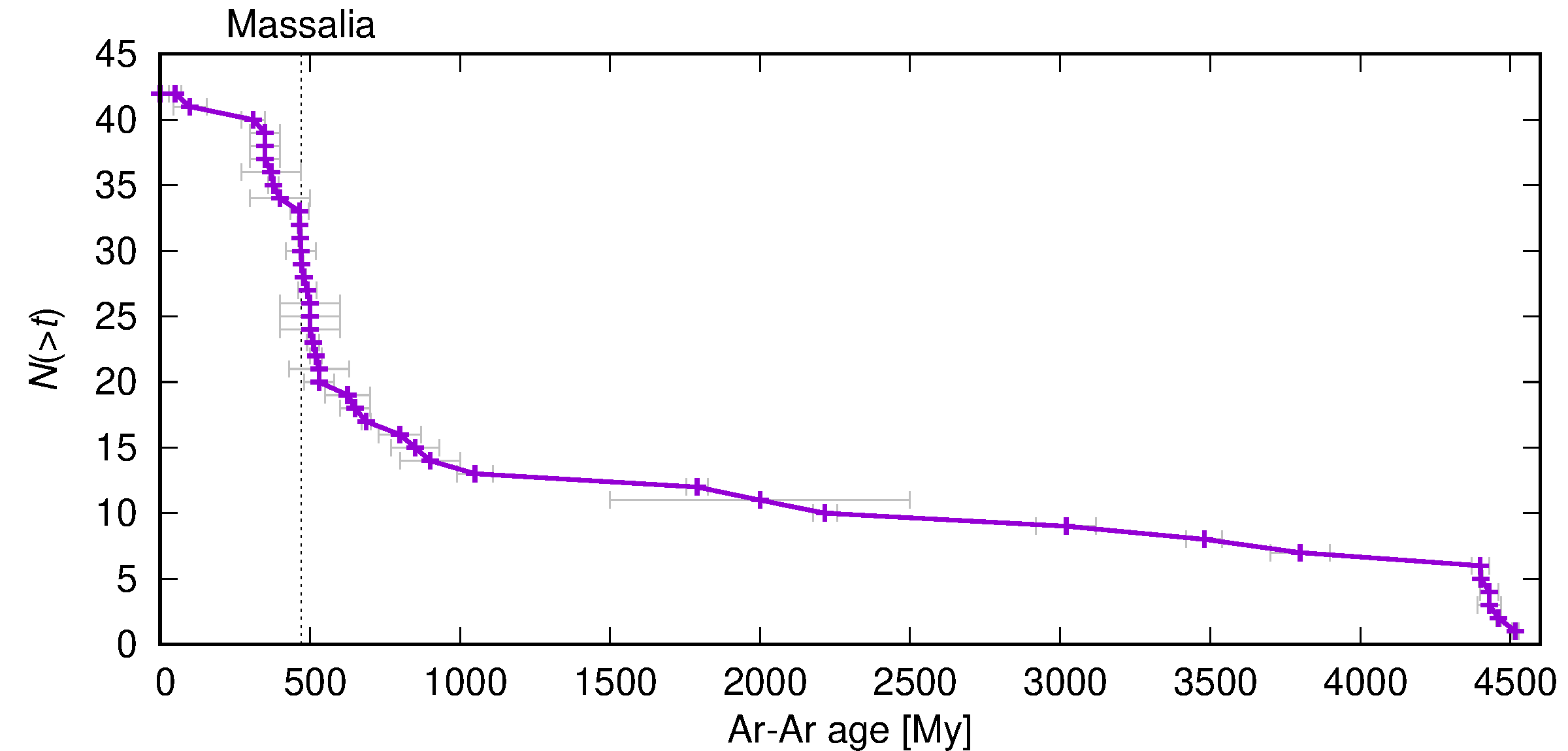 |
 |
|
| LL | |
 |
 |
|
| HED |  |
 |
||
| Euc |  |
 |
||
| Dio |  |
 |
Rheasylvia and Veneneia basins are only seen in Dio, presumably because Ar-Ar resetting occurs in mantle, just below the impact point, not in Euc (crust, regolith, far from impact point). Also, old impacts (3.5 to 4.5 Gy ago) do NOT always reset Dio, but they always reset Euc. According to CREs (~22 My), Dio must have a distinct, small parent body. | |
| How |  |
 |
||
| Mes | |
 |
 |
If Mes originate from Vesta, they were created during 1 of the impacts (cf. the narrow shock distribution)! Note exposure is much longer for Mes; high-metal content -> slow drift? |
| EC | |
 |
 |
Q: Isn't it too smooth? A cooling (formation) sequence? |
| EH | |
 |
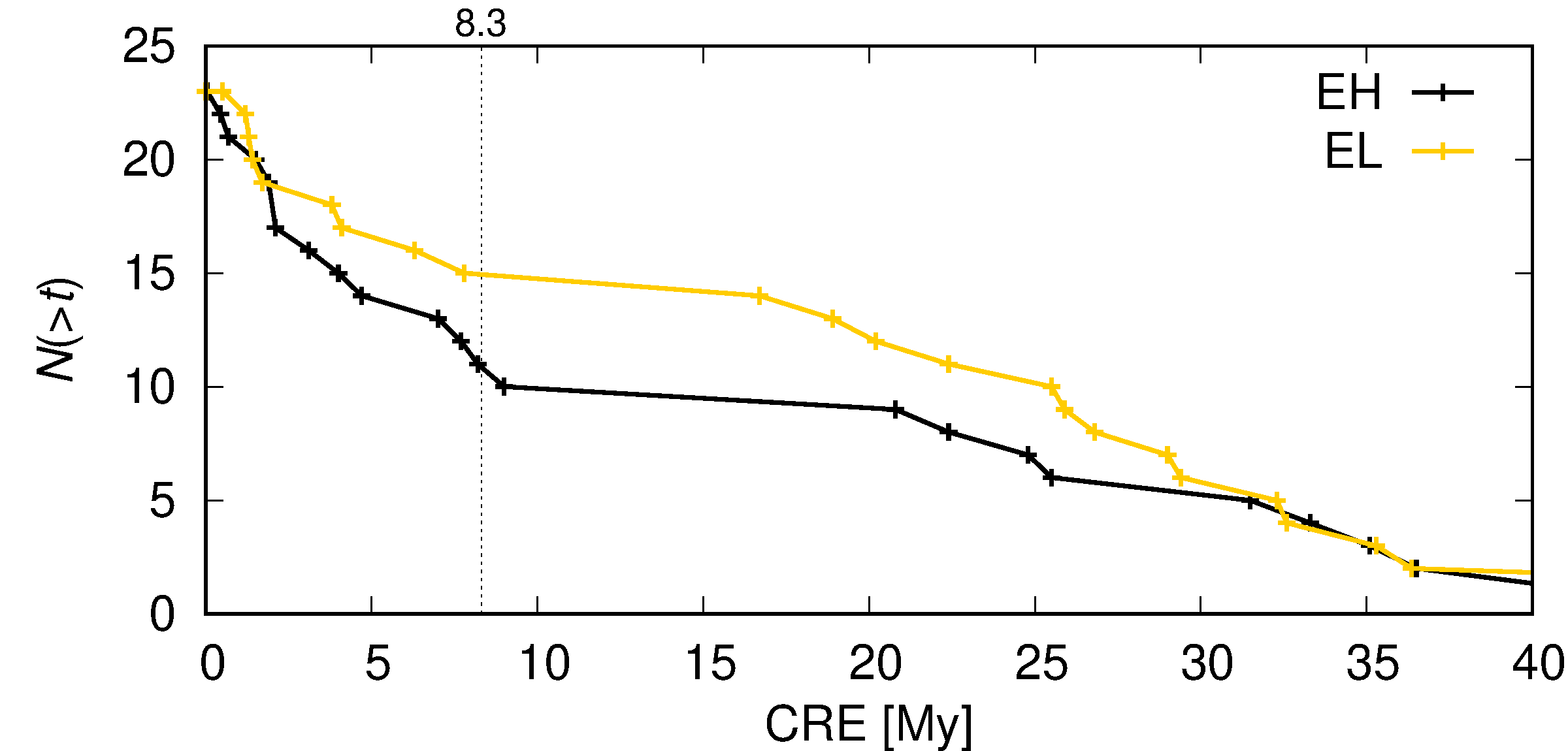 |
EL and EH ages are too similar! cf. Athor (EL)? |
| EL | |
 |
 |
|
| Aub | |
 |
 |
|
| iron | |
 |
 |
iron CRE ages can be used similarly as shock ages! |
| iron_IAB |  |
 |
 |
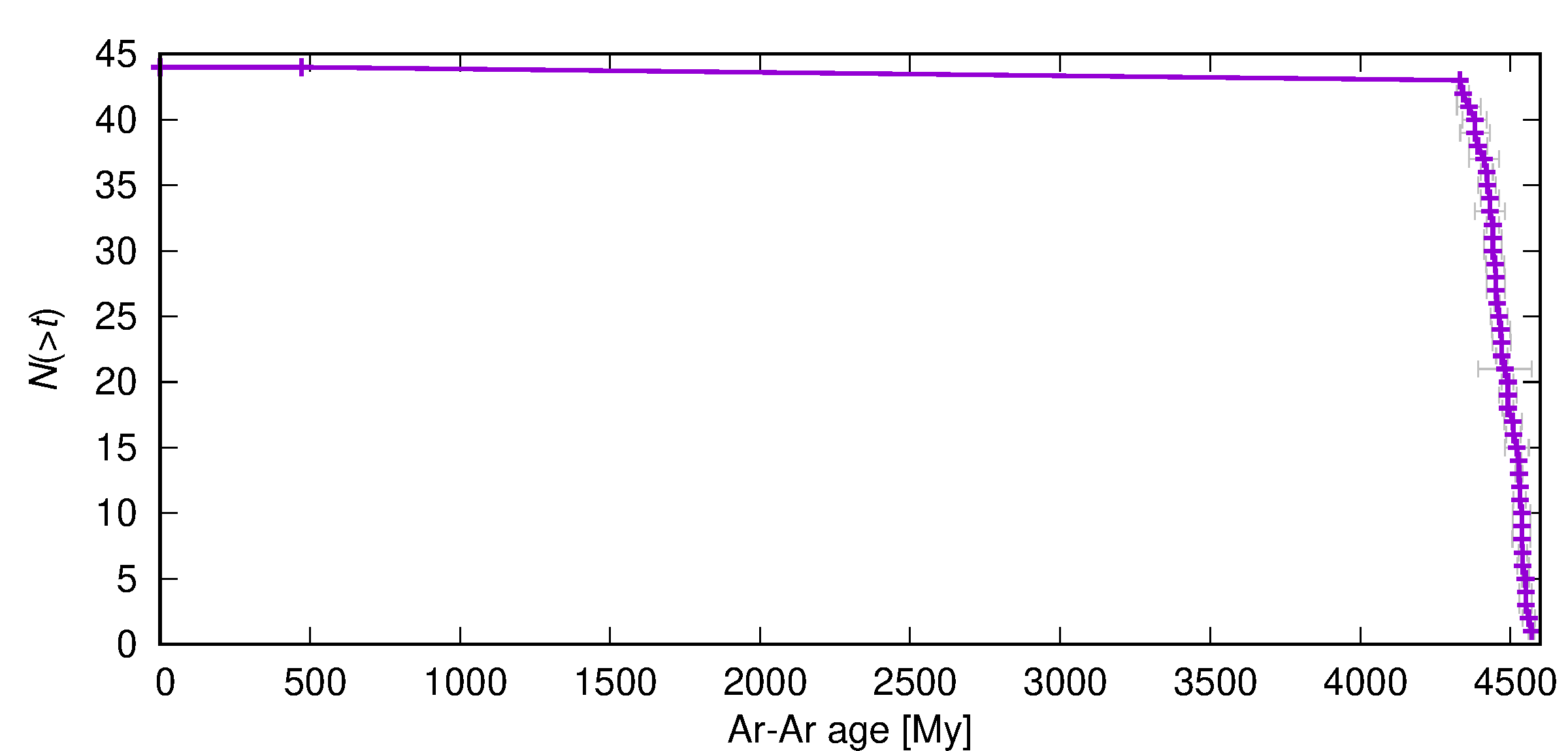
iron survives collisional cascade much longer than Win |
| iron_IAB-MG |  |
Main Group (MG) is even more consistent with Kalliope | ||
| iron_IIIAB | |
 |
iron survives collisional cascade longer than Pal; Note IIIAB are lacking silicates, K-Ar, Ar-Ar ages aren't applicable. | |
| Lun | 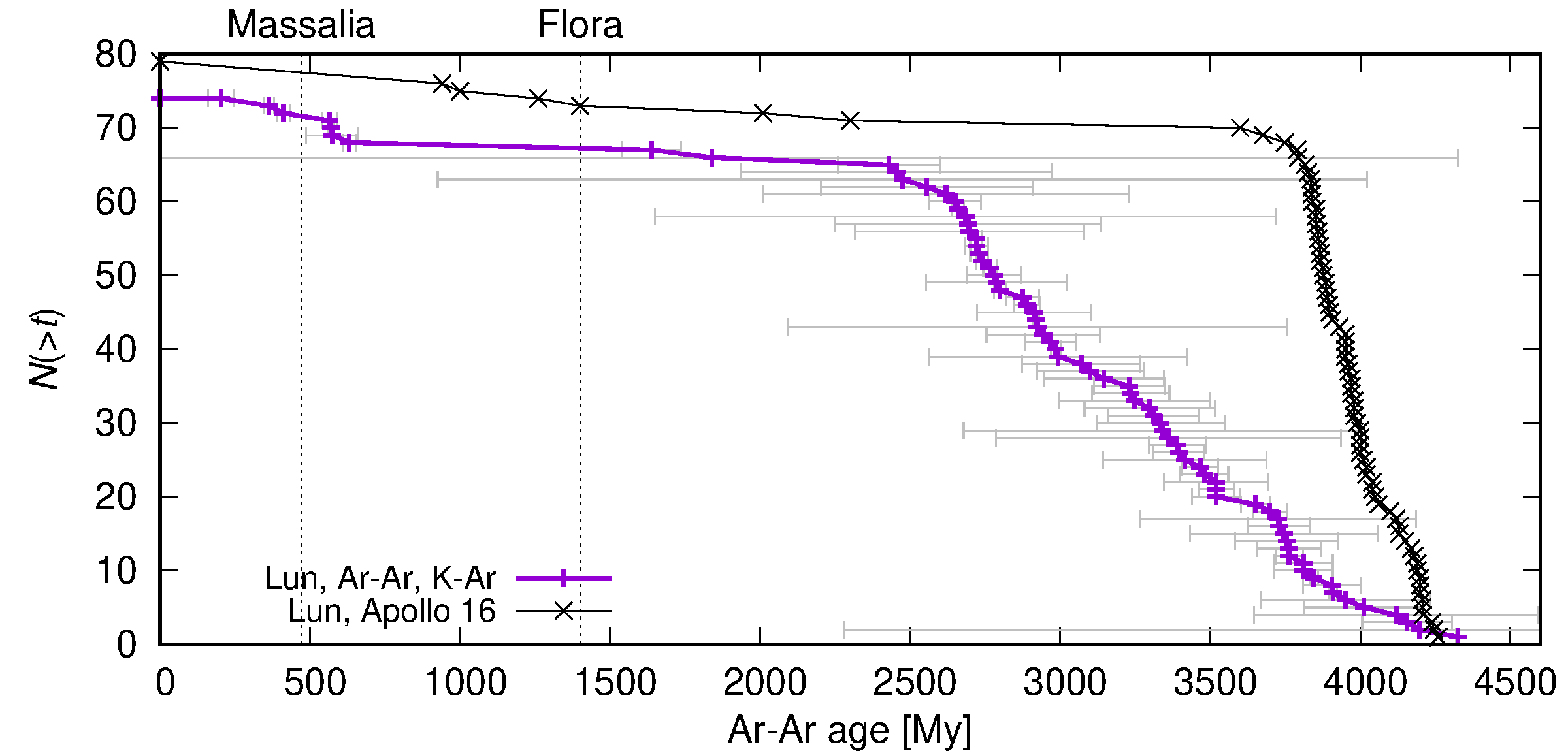 |
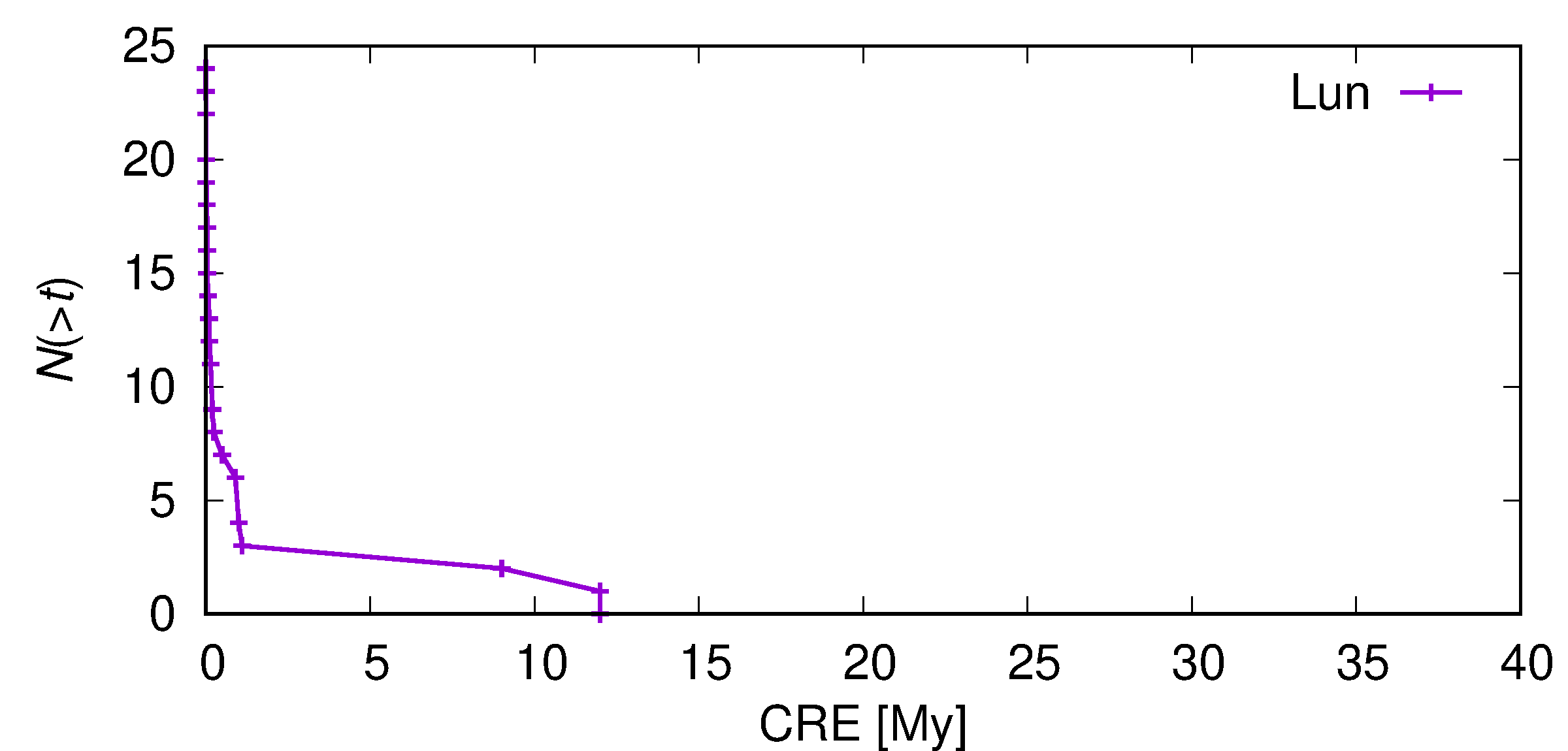 |
On the Moon, Ar-Ar may not be only shock, but formation! Q: Why Flora is not visible?! Limited area of craters? Only in Apollo 16. Q: Why Massalia is not visible?! Ditto. Only in basalts? Q: Why Apollo 16 is narrow? A specific location (Descartes Highlands). | |
| Lun-ano |  |
Q: Why anortozites have younger shocks than basalts? Isn't it due to sigma's? | ||
| Lun-bas | 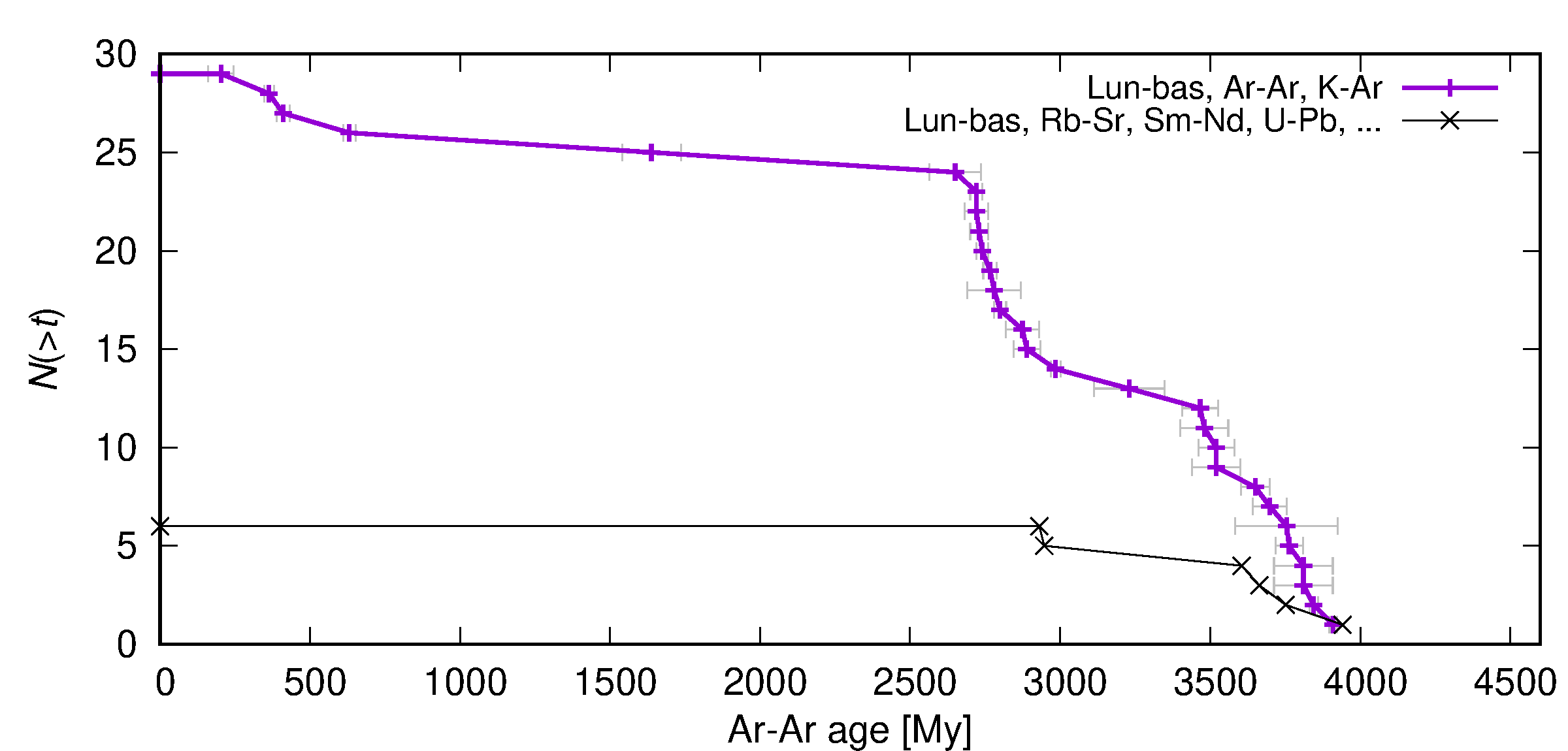 |
Q: Why basalts show 2 stages? Early vs. late maria formation? Q: Are maria more monolithic than highlands? Yes, regolith is ~1-2 m on the youngest maria! | ||
| Lun, spherules |  |
Culler et al. (2000) ages do record Flora, and perhaps also Massalia?!
On the contrary, Zellner (2015) seems to be like constant flux
and then thermal cracking (as in Atacama)?
Note that young spherules might be re-set old spherules. :-(
Notes on landing sites: Apollo 14 in Fra Mauro, Iif terrain, Imbrium ejecta. Apollo 12 in Oceanus Procellarum, Em terrain, mare <3.2 Ga old. Apollo 16 in Descartes Highlands, It terrain, megaregolith? |
||
| SNC |  |
 |
 |
On Mars, Ar-Ar may not be shock, but formation! cf. concordant Rb-Sr, ... Q: Why Flora is SO prominent?! Volcanism?! Q: Why Massalia is not visible? Perhaps, in She? |
| She |  |
 |
 |
|
| Nak |  |
 |
 |
|
| Cha |  |
 |
 |
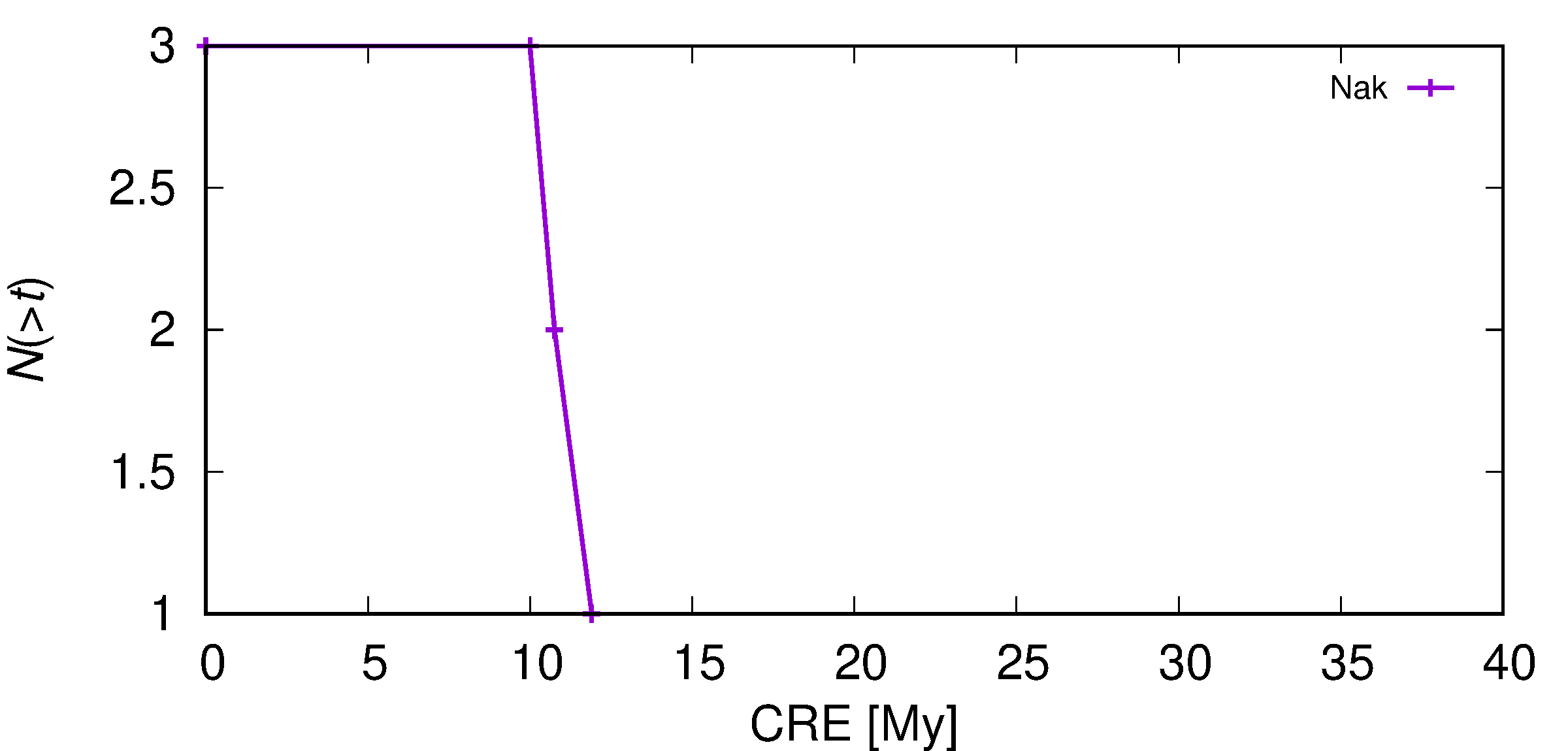
Note Cha <-> Nak |
| SNC-Ung |  |
 |
 |
|
| Ure | |
 |
 |
highly reduced (C .. graphite, diamond);
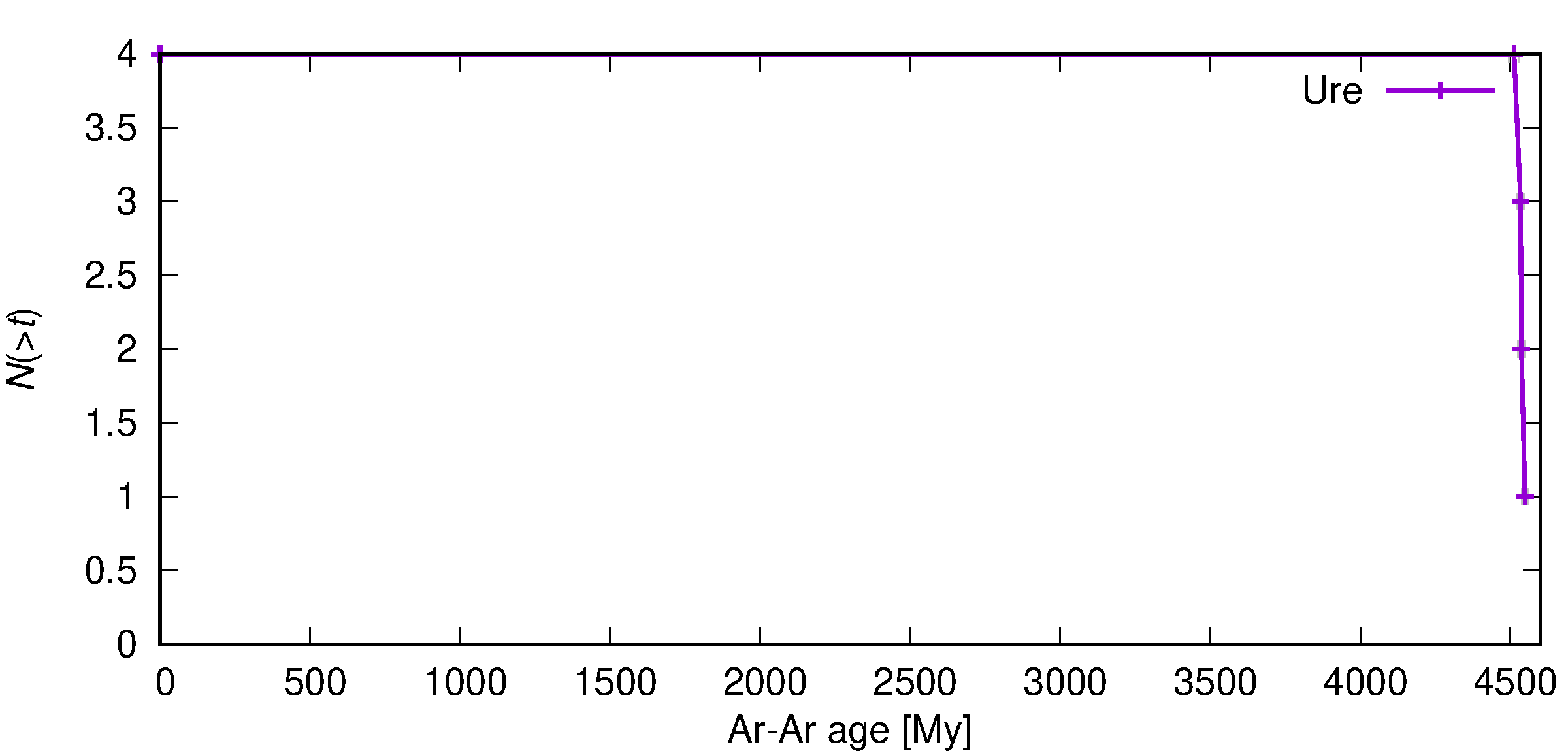
Ure are old (sic!), older than EC, OC, CC.
Moreover, they have extreme (sic!) isotope anomalies
(Warren (2011))
Should it be one of the primordial reservoirs?
Is it due to formation close to the Sun (Ure, HED+Mes+Pal, EC, OC, CC)?
Or, is it the opposite (EC, OC, HED+Mes+Pal, Ure, CC)?
Or, is it earlier?
Note shock ages are for Almahatta Sitta breccia only. |
| Ure |  |
from Leya (2019) | ||
| R | |
 |
 |
oxidized, sulfidized (troilite FeS); olivine-rich (Berlin et al. 2003) Q: close to snowline? Q: associated to Eos? cf. close to Veritas (8.3 My)! |
| CM | |
 |
 |
CM chondrites were NOT shocked enough (S1, S2) to always reset the Ar-Ar system! Q: Why no shocks during the last 1 Gy?! When CMs originate from Veritas... cf. old K-Ar data of Mazor (1970) Q: CO/CV/CK associated to Eos? cf. 2nd onset at 8.3 My! |
| CI | |
|||
| CR | |
Note CR chondrites have D/H similar to the Earth. (Alexander et al. 2012) |
